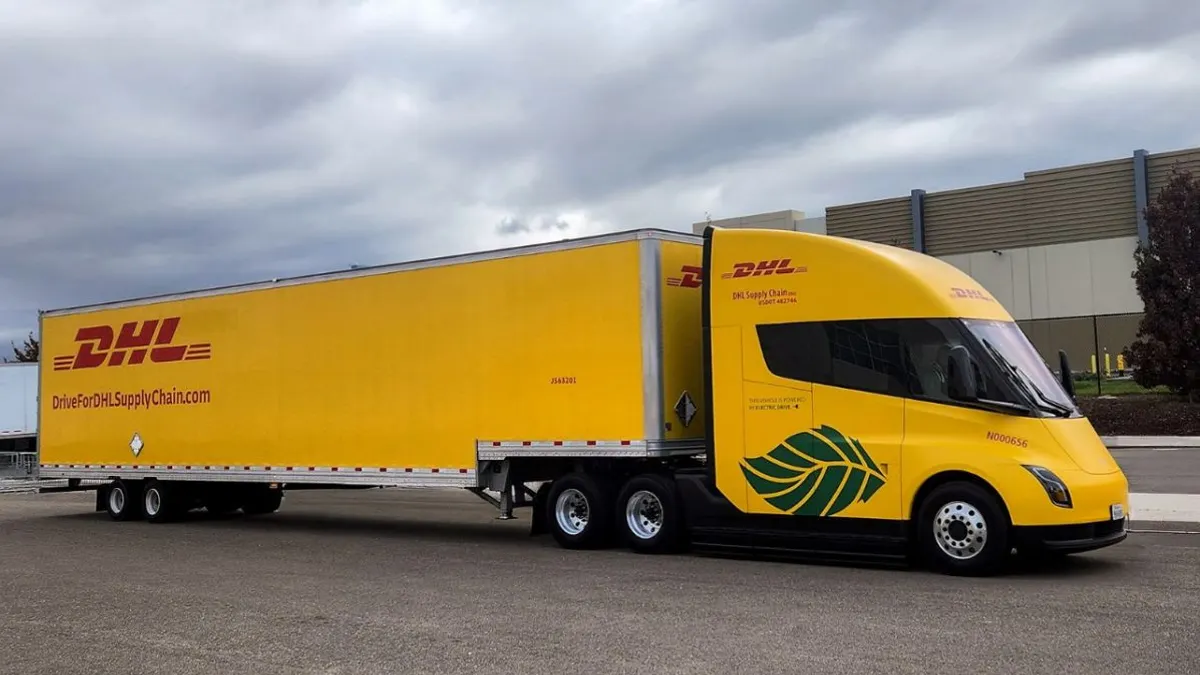
DHL Supply Chain has put a Tesla Semi into daily service at its Stockton, Calif., campus, the opening move in a 2026 plan that will add several battery-electric Class 8 tractors to 390-mile routes hauling 75,000-lb payloads and, by the company’s math, erase roughly 50 t of CO₂ a year.
Tesla Semi completes 390-mile loop on single charge
The pilot truck now covers 100-mile segments inside a regional circuit that starts and ends at the Stockton distribution center. Drivers recharge once a week; the 500-mile EPA-rated pack still shows 20-25% charge after the 390-mile round, gross-weight sticker included. Engineers are logging charging curves, brake-regen recovery and payload-specific efficiency before route expansion starts in Q4.
Battery-electric rigs now 41% of DHL North America fleet
DHL already fields 150 zero-emission vehicles—from Ford E-Transit vans to Volvo VNR Electric day cabs—outpacing many regional carriers’ entire fleets. The Semi pushes the battery-electric share past 41% of all on-road units in the United States and Canada, putting the company about two-thirds of the way to its 2030 electrification target. Each heavy-duty swap removes annual emissions equal to 12 passenger cars, EPA data show.
Ground freight emissions fall 5.7 points in 12 months
Renewable electricity now moves 18.4% of DHL’s road shipments, up from 12.7% in 2023, the steepest one-year jump across any transport mode. Because trucking generates 22% of corporate CO₂—second only to air cargo—depot charging is viewed as the quickest lever for science-based goals. Stockton’s 1-megawatt cabinet pulls from a grid mix that is 52% solar and geothermal, widening the Semi’s well-to-wheel advantage.
Rivals test parallel paths toward 2035 emissions cliff
Werner Enterprises is piloting hydrogen fuel-cell, renewable natural-gas and renewable-diesel options, aiming for a 55% cut by 2035. Estes Express Lines plans zero tailpipe emissions for 90% of its box-truck fleet by 2040. All three carriers cite the same bottleneck: public high-capacity chargers built for 80,000-lb tractors remain scarce outside California’s Central Valley and the Texas triangle.
Stockton depot charging timeline becomes critical path
The 1-megawatt DC system took 19 months from utility application to first plug-in—standard in Pacific Gas & Electric territory, where 12-kilovolt feeder upgrades require new transformers and meter bays. DHL’s 2026 roadmap counts on four additional Semis, but procurement contracts include a 24-month buffer after Tesla’s 2023 production reboot delayed several fleet handovers. The clause, now common at Knight-Swift and NFI Industries, lets buyers stagger deliveries without losing production slots.
Useful Resources
- North American Council for Freight Efficiency (NACFE) – free guidance on electric-truck total cost of ownership and depot charging design
- California Hybrid and Zero-Truck Catalog – state database of incentives, specs and approved vendors for Class 4-8 electrics
- EPA Greenhouse Gas Equivalencies Calculator – converts fuel or kWh savings into metric tons of avoided CO₂
- Tesla Fleet Portal – order tracking, driver training and charging analytics for Semi customers
Source: DHL Supply Chain press release and route data, May 2024